
Dispatch 02: Perpetual Improvement

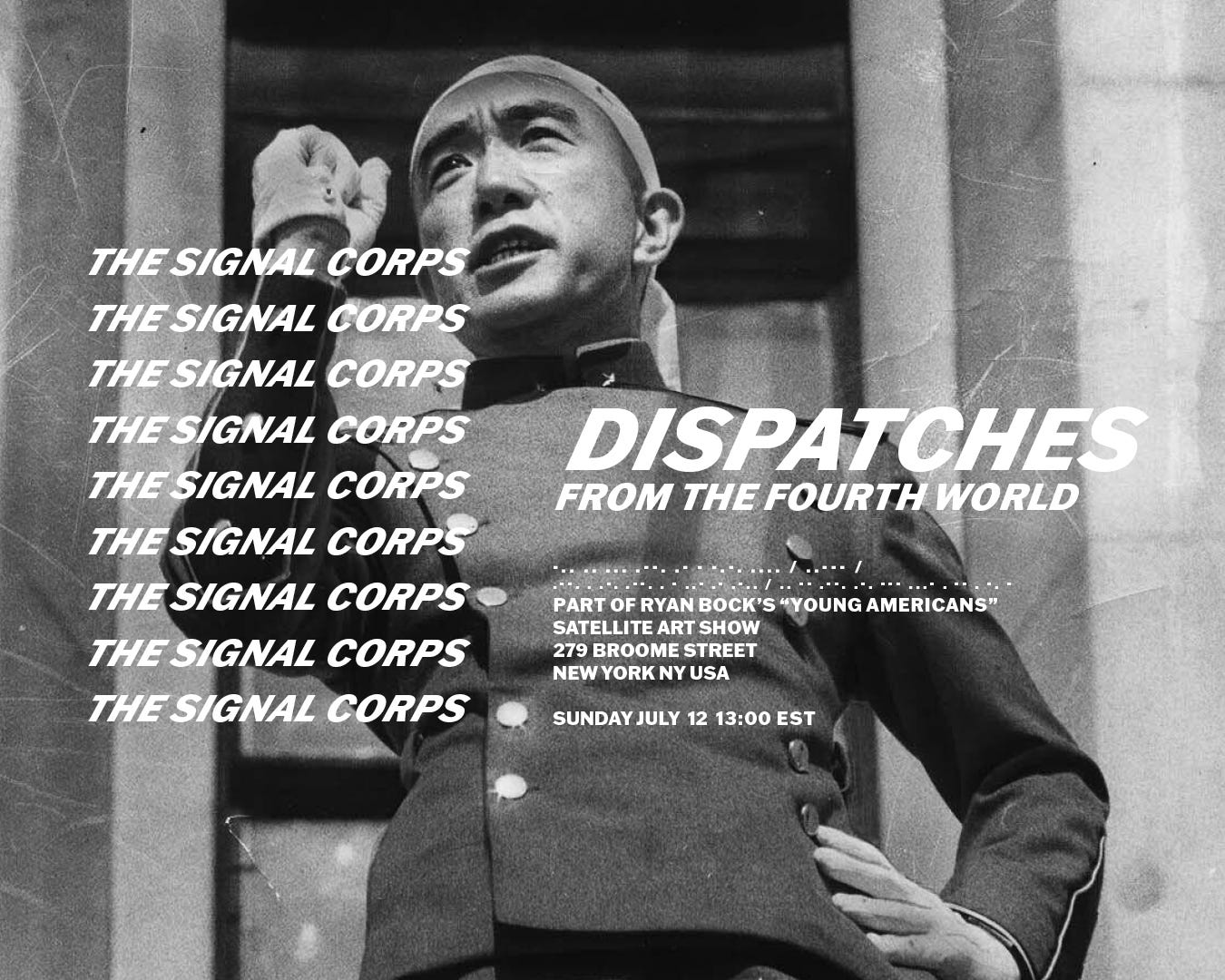
What follows is a transcript of a recorded conversation between Joseph Cochran, representing the Signal Corps, and guest Luke Ivy Price. Recorded live at Satellite Art Show, 279 Broome Street, New York, sited within Ryan Bock's exhibition Young Americans. 1300 hours, 12 July 2026.
We are the Signal Corps. I am the representative of the Signal Corps, Joseph Cochran, and today I want to talk about bodies — not in an aesthetic manner, well, a little bit in an aesthetic manner, but more in a curatorial one. That being said, here is the read.
On November 25th, 1970, Yukio Mishima stood on a balcony in Tokyo. He’d taken the military commandant hostage through his private militia and demanded the soldiers below him rise and restore the empire. They laughed at him.
Five times nominated for the Nobel Prize, he was the most important Japanese novelist of the 20th century — a man of extreme intellect but also of physical perfection. He built his body, modeled it after Greek sculpture, and, in line with his imperialist, nostalgist beliefs, trained in the sword, or at least was photographed as if he were a master. He compiled his musings on the physical form into the book Sun and Steel. His argument was simple: the body, perfected through iron and pain, is the only honest counter to a world gone soft. Words lie; the flesh does not. And the flesh, to mean anything, must face death.
This is a nationalist argument. But it is also something else. Consider who he photographed, who he wrote about. The body depicted through his fiction — all the ambitions that organized his work were rooted in a desire of men. Not just any men, but elite, strong men. Nationalism proved the frame that made the desire publicly permissible.
In Japan, an entire generation of men built their identity around the warrior ideal — purity, sacrifice, the body as offering to something greater than itself. Then they lost. The ideal didn’t survive contact with reality. What remained was the trauma of men who had organized their entire selfhood around a mythology proven wrong. Mishima was one of them. He spent thirty years trying to rebuild what that defeat had destroyed. The coup would never come, and Mishima — who had meticulously planned his demise over a year prior — killed himself through seppuku: a fitting end for a man who considered himself the paragon of true Japanese society.
In Nazi Germany, a regime that built its entire ideology on the foundation of Aryan masculine supremacy also circulated Die Freundschaft , a gay magazine, among its ranks. This is notable, since the Nazis actively legislated against homosexuality. Their political grandstanding was performance — formed around the tension between homoerotic military brotherhood and the Vaterland.

I could walk us through endless examples: individuals and nations finding strength through worship of the perfect, infallible man — not just a revelation but a judge, a totalizing, actualized figure in a sea of mediocrity. For the last forty years or so, the United States has flirted with these ideas. The Reagan era produced pop-culture archetypes that sought to restore an American masculinity thrown into flux by foreign-policy failures — Vietnam, and soon, Iran-Contra. You asked why we were giving the Contras money; we gave you Schwarzenegger, Stallone, and Lundgren — actors whose characters embodied American power through resourcefulness, but also physique. (We also had Billy Blanks, but that isn’t the story we’re telling tonight.) These figures showed Americans the ideal of a new Lebensraum — one of perpetual improvement, where men set the standard not just for physical perfection but for moral, economic, and philosophical life. It was Mishima’s dream, but with no gods or masters — Jesus Christ himself, for some.
That veneer followed us into the new millennium, but by the end of H.W. Bush’s presidency, and later Obama’s, a general malaise came over American life, especially around its men. Spikes in obesity, the advance of women socially, politically, economically, the movement toward a more perfect union racially — who knows what actually drove it. But by the time Trump entered office, the perfect man once again emerged, albeit distorted.
Brian Johnson is 47 years old. He has spent millions of dollars trying to reverse his biological age. He has transfused his son’s blood into his body. He measures every system, optimizes every variable, photographs his results, and posts them for an audience of men who watch, evaluate, and compete. He calls it a project. It is a performance. The audience is always male. The validation is always male. The tech oligarchs who run this country perform dominance for each other. The Trump cabinet is a masculinity pageant. The manosphere has built elaborate systems — scales, hierarchies, rankings — for men to evaluate other men’s bodies, faces, and worth. The stated goal is attracting women. The actual audience is always men.
And then there is the case of Brayden Peters. Twenty years old. He calls himself Clavicular. He has smashed his bones with a hammer. He has used steroids until he made himself infertile. He has used crystal meth to hollow his cheeks. He ran a man over in a Cybertruck and asked his passenger if the man was dead. She didn’t know. He said, “Hopefully.” The camera was running the entire time. He ended up in a hospital in Florida. He got there because someone told him, when he was young enough to believe it, that his body as it naturally existed was not enough. He believed it. He gave everything to that belief. The belief did not give anything back.
I want to be precise about what I am saying and what I am not. I am not indicting desire. What a man does with his body, who he loves, what he wants — that is his own; that is not the subject. The subject is the performance. The machinery built to deny what is plainly there. The violence that machinery requires to sustain itself. The casualties it produces: the twenty-year-old in the hospital, the generation of Japanese men who never recovered, the men in the Third Reich who legislated against their own desire and organized pogroms to prove they meant it. The body is not the problem. The lie about the body is the problem.
Look at these walls. Ryan Bock has been painting American archetypes for a decade — the Klansman, the policeman, Uncle Sam, the devil with his fiddle. Puppets. They only move when you pull the string. Without our participation, they are wooden paint. I am filing this dispatch from inside of that.
Murrow used to say, “This is London.” He said it so you knew where he was standing, so you understood what that position made visible. This is the 250th year of the United States of America, and this is what I see from here.
The man I’m about to bring into this conversation helped build the space that made this evening possible. He’s a painter. He came up working with his hands — cotton mills, construction, the materials of labor before the materials of art. His work lives in the body too, but a different body — one that knows what it wants and doesn’t apologize for it. One built for intimacy rather than domination. Luke Ivy Price.
