

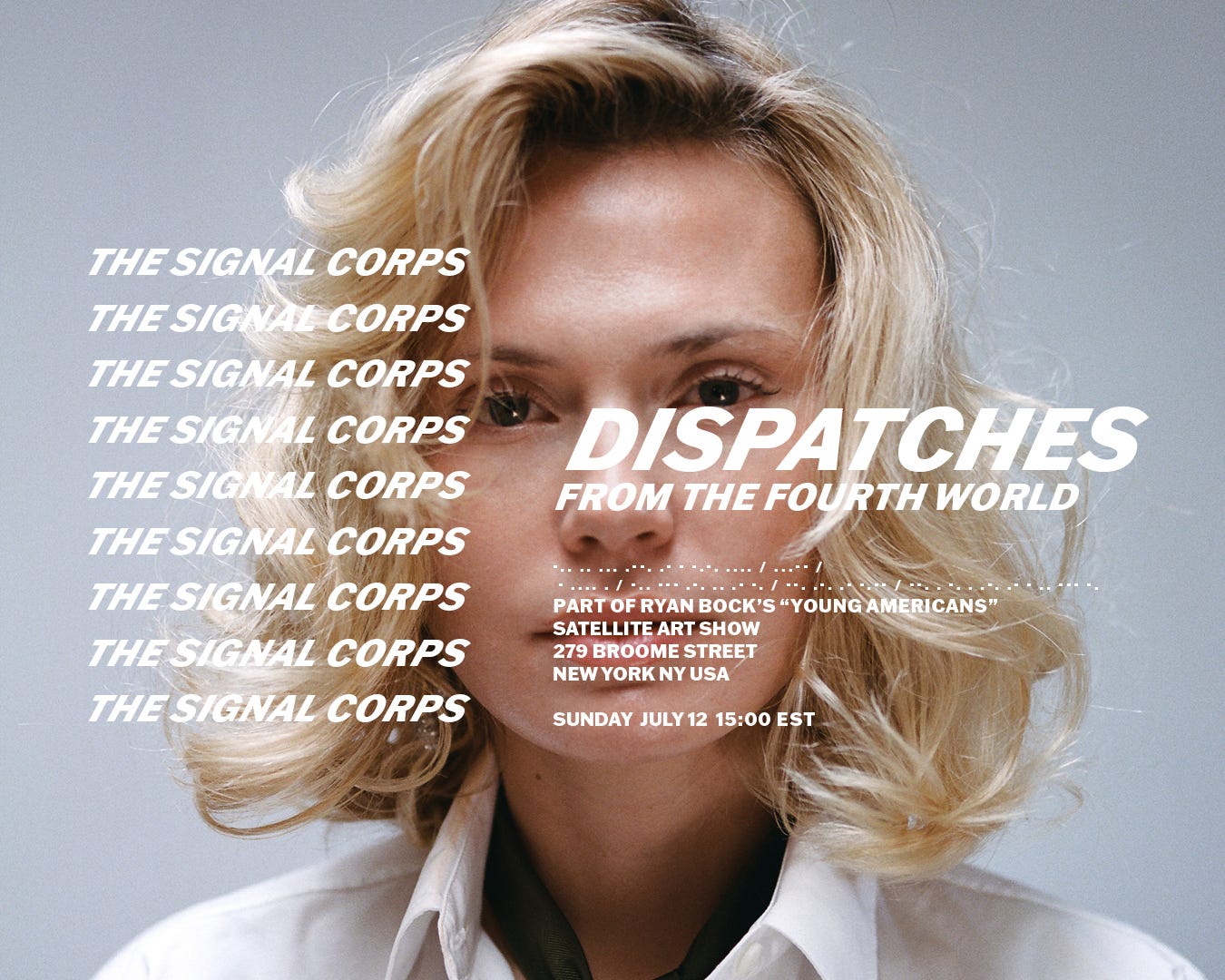
What follows is a transcript of a recorded conversation between Joseph Cochran, representing the Signal Corps, and guest, The Gallerist Ki Smith Recorded live at Satellite Art Show, 279 Broome Street, New York, sited within Ryan Bock's exhibition Young Americans. 1500 hours, 12 July 2026.
On May 31st of 2026, Hilde Lynn Helphenstein was found dead in a São Paulo hotel room. She was 40 years old. An empty vodka bottle, broken bottles, and unidentified pills were found beside her. Her plastic surgeon, the one who came looking for her, had already taken her to the emergency room days before.
Police called it suspicious. The art world called it a tragedy. Both perspectives are probably true, yet both lack what we at the Signal Corps think to be integral — the broader, more important takeaway.
Helphenstein built the Jerry Gogosian account in 2018 while recovering from a tick-borne illness that put her in the ICU for 16 days, cost her her gallery, and sent her home to her childhood bedroom at 33. Anonymous at first, acerbic always, she spent eight years naming the art world’s pathologies with enough precision that 150,000 people followed her to receive those musings. She commented on it all — the sycophancy, the money laundering dressed as taste, the abuse of power hiding behind prestige. When Gagosian director Sam Orlofsky’s conduct came to light, she used the platform to make sure it didn’t stay quiet.
In my research for this episode, there is something I keep returning to. Despite the critique and influence she accumulated, she said herself in an interview with the Carl Jung Institute of Chicago, recorded not long before she died: “Jerry saved my life, and then Jerry tried to kill me.”
I didn’t know Hilde Helphenstein. In fact, when she began her musings, the Signal Corps was still in its infancy, living under Chinese censorship, oblivious to her existence. I say this to establish: this is not an elegy. We do not seek to beautify Helphenstein. She is but a parable, one that will help us illuminate something we refuse to be honest about.
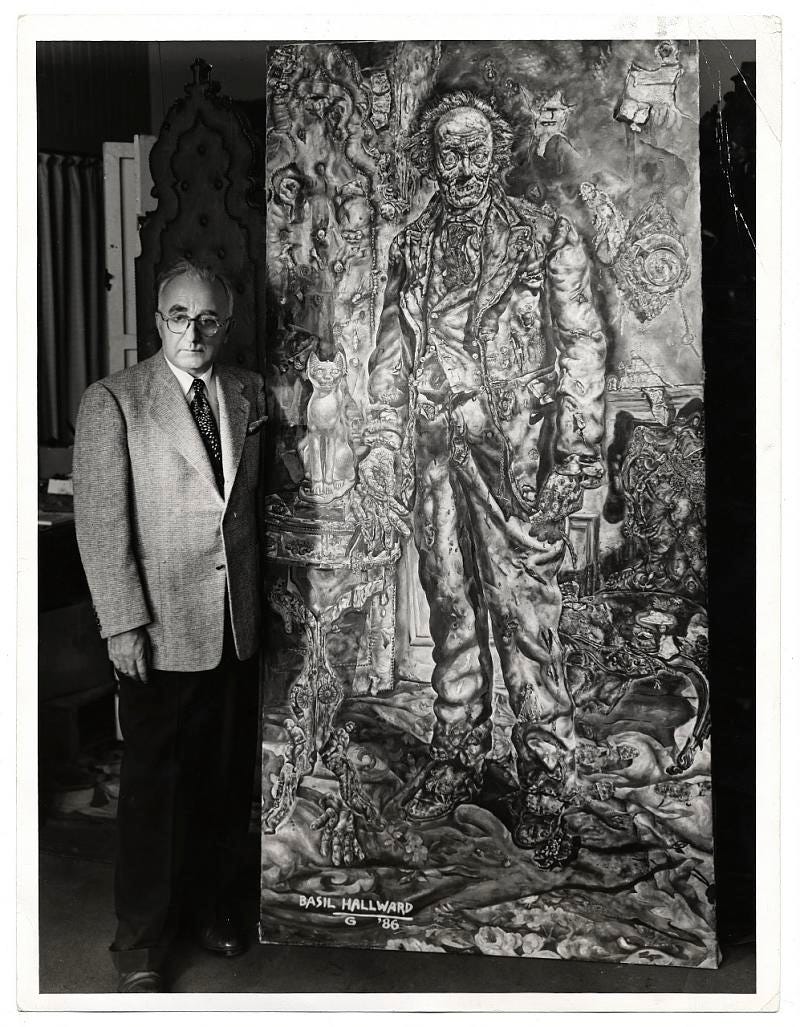
Oscar Wilde published The Picture of Dorian Gray in 1890. The premise is simple and merciless. A beautiful young man wishes that a portrait of him would age in his place so that he might remain forever young while the painting absorbs every consequence of his sins. The wish is granted. Gray moves through the world pristine, untouched, curated. The portrait rots in the attic.
The novel makes clear what light readings of the masterwork miss: Gray wanted it. He didn’t stumble into the bargain. He wanted eternal youth badly enough to make a Faustian deal. The desire is what makes the tragedy. Without the wanting, there is no story.
I’ve been thinking about this generation as the Dorian Gray generation. Not because we are uniquely vain, though the evidence is available, but because the infrastructure of late-stage neoliberalism combined with algorithms that incentivize and reward spectacle above everything else has produced the same bargain Wilde’s protagonist made. You give the platform your image. The platform holds the consequences. You keep performing.
What makes this generational is not weakness or vanity. It is the absence of alternatives. This generation didn’t inherit a world where another path was visible. The neoliberal order had already consumed the counterculture, the avant-garde, the political movements that might have offered a different set of targets for desire and ambition. What remained was the market and the algorithm. So the desire gets aimed at the only targets available — the room, the platform, the persona, the brand.
Helphenstein wanted the life. She worked for Gagosian. She ran a gallery. She went to NYU Stern. She went to the Hamptons. She collected art. She wanted in, and she used the persona to get closer even as she was critiquing it. The desire and the critique ran simultaneously. She wanted the room and knew the room was corrupt. Both things were true the whole time.
That is not a contradiction. That is the more honest and more complicated story. And it is the story the art world will not tell about her because telling it honestly would require the art world to examine what it does to people — specifically to the people who are lucid enough to see it clearly and still can’t stop wanting what it offers.
Herbert Marcuse called this one-dimensional thought. In his 1964 study of advanced industrial society, he described a form of domination that no longer works through force. It works through integration. The system doesn’t need you to love it. It needs you unable to define your own needs as anything other than the needs it has already given you. As Marcuse wrote, the result is “the integration of all opposition in the established system.” Your critique, however sharp, however accurate, gets absorbed into the whole. It becomes content. Content becomes brand. Brand becomes another product the system sells back to itself.
The one-dimensional person, Marcuse wrote, “does not know its true needs because its needs are not its own. They are administered, superimposed, and heteronomous.” The system is most dangerous not to the ignorant but to the lucid. The ones who see it clearly, name it precisely, and still cannot escape wanting what it offers — because it has arranged the world so that there is nothing else to want. Seeing the trap doesn’t spring it. That is the generation. That is what her death means beyond the personal tragedy.
Any platform with real reach carries a moral obligation — not just to reflect but to illuminate, to make the sustained argument, to stake your name and your reputation on what you believe is true and say it with enough gravity that people cannot look away and call it entertainment. The meme can puncture. It cannot build. That is not a failure of intelligence or intention. It is a structural limitation of the form.
Helphenstein knew this. Towards the end, she tried to rebuild the platform into something more sustained — the MBA, the market analysis, the philanthropic arm. But by then, the audience wanted Jerry, not Hilde. She became, in her own words, an actress who could not get out of the same role after seven years. Every time she said this is not a performance anymore, the audience said there’s the performance.
150,000 people who loved Jerry. Hilde in a London apartment, agoraphobic, not giving anyone the address.
That is Dorian Gray.
The art world is not going to reckon with what her death means. It has mourned, posted, and moved on. There is simply no time to examine itself.
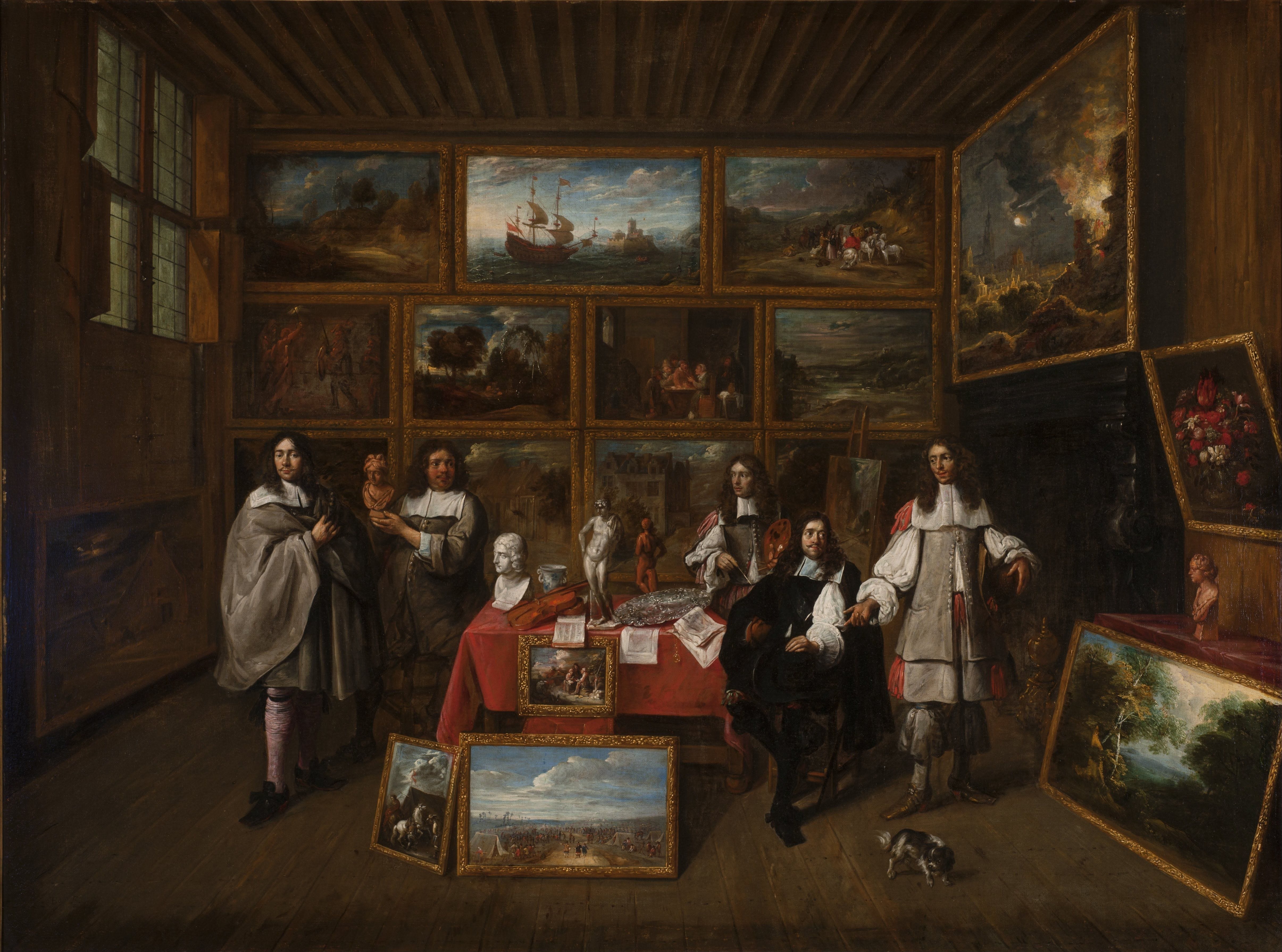
Today, I have brought on someone who I think, though I am not certain if he knew of this figure or not, understands through observation some of what I have spoken about. His name is Ki Smith. He is a gallerist and the founder of Ki Smith Gallery on the Lower East Side, which opened in 2019. He entered the art world at 16 and co-founded Apostrophe NYC at 21.
He operates the machinery we have spent this hour examining. He decides which desire gets channeled, which work gets shown, which artists get access to the room. That is not an indictment of him. That is simply how things operate. I believe he is personally a theorist, but professionally he does not have to be one. He is the infrastructure itself — the point through which the system moves its capital, its people, and its judgment.
We brought him here because the conversation between the person who wanted in and the person who operates the entrance is the conversation that we need. Again, this is not to blame him or put him in any sort of moral category, but to understand what this system, if there is one system, actually requires from everyone inside it.
Everyone, Ki Smith.
JC: How are you doing?
KI: Doing good, thanks for having me.
JC: Good, good. Yeah, what do we got here? So, you know, I mean, to connect to the read a bit, obviously you knew of Jerry Gogosian, yes?
KI: I knew of her. I didn’t know her personally. A friend of mine was dating her for a while, but that was about the extent of it. I also didn’t know her account very well. I wasn’t one of the 150,000.
JC: Okay.
KI: Actually, who knows? I might have been because I have just the gallery Instagram, and I don’t always run the gallery Instagram. I’ll bet we were part of that 150.
JC: So you’re not watching what’s going on algorithmically?
KI: I wasn’t, and I will say in general, there’s a certain amount of watching that I let myself miss out on. Why? Because I think that it’s important to be aware of what is going on, but to be hyper-aware of trends will unconsciously push you into following those. And then I think by following them, by definition of following, you’ll be behind. Right. So it’s important to obviously be aware of what is going on, the surroundings, the general environment of the industry, but I think to get too on the pulse of things will put you in a position that you’ll actually never be on the pulse on the creation side. It’s almost as if cutting edge is a fool’s errand.
JC: Yeah, more or less. You want to be on the bleeding edge.
KI: Yeah. People are worried for you. The reason they call it the bleeding edge, right?
JC: For sure. I think that at least for me, and maybe the empath in me, when I saw the headlines and read the story about her passing, I just did this whole rabbit hole and saw how she spoke about the industry coming and going, spoke about how things progressed from this actual critique to this sort of like, what the fuck, how much have I done? Am I not in this yet?
And in our pre-conversation when you were riding upstate, there was something that you said that spurred me wanting to put Helphenstein as the read to this, which was — so many people are aware of the tool - I’m paraphrasing - but something like “so many people are aware of the tool, but they don’t see that there are many tools around them”. And I think in Helphenstein’s case, she went from like, I’m from this backwater in Florida, and I’m an outsider coming in talking shit about all this because it’s all stupid, to how come I am not a part of it? Have I not done enough?
And I get the total opposite from you. I get the notion that you move to the beat of your own drum, though you are aware of these machinations. So if you could kind of dive into that musing for a moment.
KI: Yeah, I can. Also, super random question.
JC: Please.
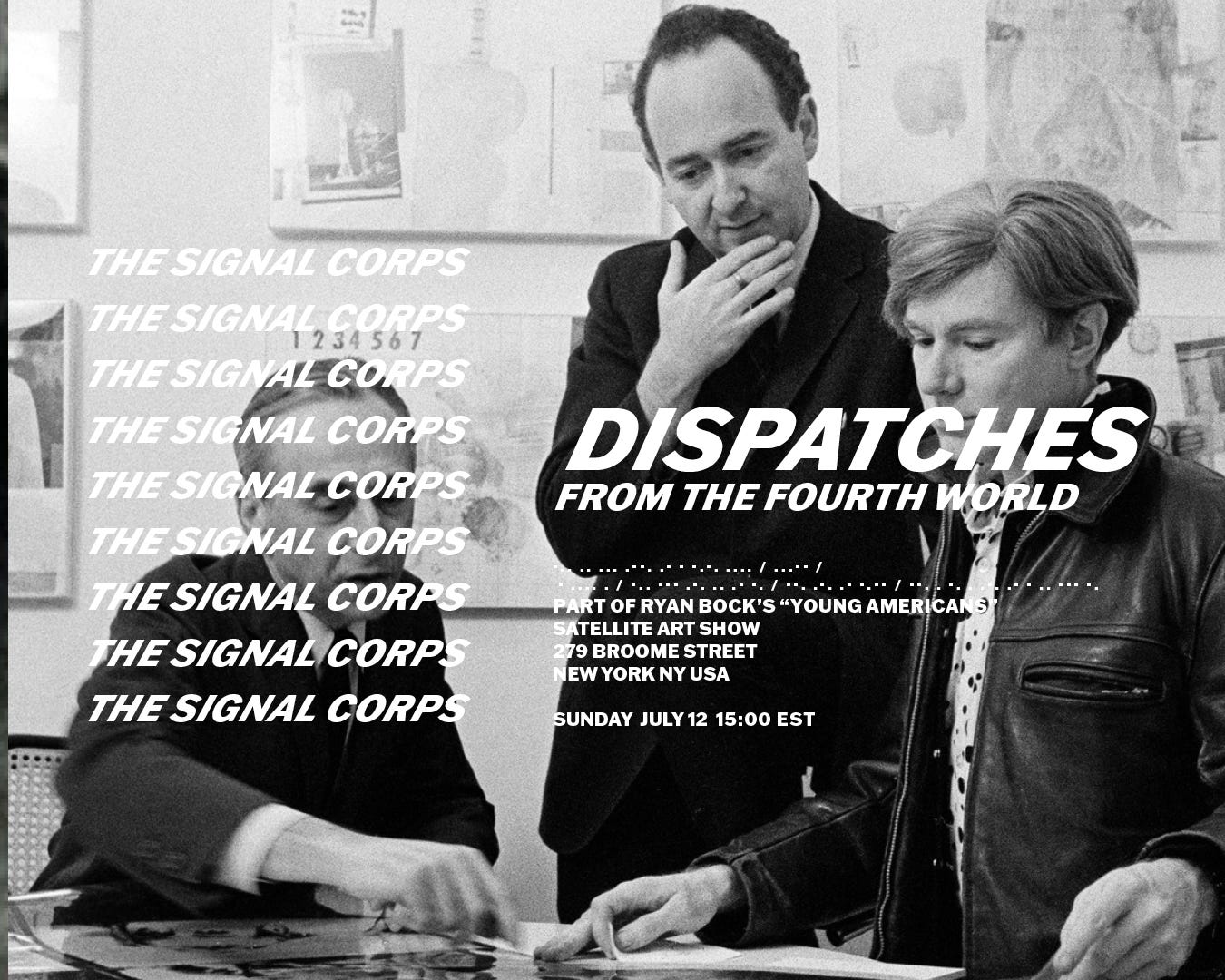
KI: So on the Instagram post, there was the caption of all this kind of stuff. But then you took a photo from 1966, an article that ran from Warhol’s first show at Castelli.
JC: Yeah. It wasn’t the first show, but it was the show that you did.
KI: Of just like them in the back with Ivan Karp and Leo Castelli. What’s the caption? I was very surprised to see this photo. I was like, well, this is crazy because literally just a month ago, I was speaking with someone that was involved in that first story, this guy Jeff Roth, and he had sent me those images.
JC: Oh, crazy.
KI: And he sent me those images, and I was like, oh, that’s crazy. And then I saw this post, and I was like, what the hell? I can’t confirm. I have never met this fellow.
JC: Right. So I took that image because, again, in our pre-conversation, you mentioned how you had a connection to Castelli, which if you’d like, you could speak about now. But I also feel that — and the Signal Corps, we are fans of Castelli. I think Castelli’s legacy is stronger than what came of it. But I think also he is sort of an inflection point that is the precursor to all of this.
And something I try to do with all the Signal Corps episodes, at least visually, is more so the images that I choose to use for promotional materials speak to what I’m speaking about more than what the guest is. I could have written the copy and, I don’t know, Whitney Mallett could have been coming on, or some poet somewhere or some shit. Anyone could have been coming on.
But I wanted you in particular because one of the things that I got from you from the beginning, and I think this is something that maybe you would know better — I think something that Castelli also understood was that he understood how to take in multiple perspectives. He understood his perspective as the gallerist, but he also had this close relationship with his artists that I think you yourself have, at least from my understanding of you working with Amani or Ryan or various others that have come through your establishment.
So that’s kind of the background of that.
KI: That’s sick. Okay, so back to the question. Talk more about the outsider insiders.
JC: Yes, yes, yes. Yeah, I mean, I think that’s a really interesting one because I think that inherently everyone starts as an outsider of sorts. Do they, though? Unless you’re born into some sort of inside, but then you’re born into being the little homie of the inside. So it’s kind of like — and in that sense, you’re also still technically in some sort of way outside of that room. So you could be born into the house but still outside of the room.
KI: Yeah.
JC: And I do think that something is interesting with her story, and this is obviously without knowing much about it. Most of what I know about it is from what you just read.
KI: I think it’s an interesting situation where the art world in general is very attractive for people to be part of. And the way that people portray the arts and the large numbers that are swung around in the arts and the idea of this kind of success and all these kinds of things like this, they become very shiny. Right.
And then once you start penetrating further into it, I think it’s really interesting because I’ve had a few of these moments throughout my kind of run of things like this. I guess at first, I first got into galleries and stuff like this. I was kicked out of high school, and basically my parents said I could either go get a job or go back to school. And I walked into a gallery actually not that far from here, the Storefront for Art and Architecture, and started working there.
I think that the first space that I opened myself, which was with my brother, was Apostrophe NYC out in Brooklyn, and it was an art gallery and a nightclub. And I think one of the big inspirations around opening that space was to be the access point, like you were saying — sort of a conduit. Being a conduit because I think that one of the biggest hurdles or thresholds for both artists as musicians or as visual artists is having that venue to perform or exhibit.
And so if all of a sudden you can become the person that gives that, then you have that freedom to work with folks and bring up new voices. I think the really interesting part is that we did this for many, many years and did different pop-up things, and we’ve had varying amounts of success and failures in that project.
And then I did come to a realization at some point where, okay, we’re putting our selected artists and folks on, but the platform that we have is still very much a different world and universe from the quote-unquote establishment or that room. And how do you start bridging those gaps? How do you actually figure out, instead of just saying, okay, well, I’ll create my own? Which is great. You create your own, you start doing your own, but then you do realize that no matter how big your own is, you have to penetrate that world in order to merge the two and eventually take over.
And so I think that’s kind of what I’ve been doing more with my gallery, Ki Smith Gallery, since 2018 — kind of understanding that you can build something to a point, but you’re still going to be on the outside unless you can find creative ways to penetrate inside and capture the attention of the establishment.
I think that one of the things that she was able to do really well was basically taking tropes and jokes and things that insiders would know and then kind of cracking fun of them to combine the folks that are learning about these things, the folks that would know, the folks that are interested in this kind of stuff, the art students and stuff like this, and then also the people inside also like, oh, kind of like in a weird roast way. But to your point about what I guess you would call a glass ceiling, it appears that not only in her case, but in a lot of artists and other movers and shakers, if you will, in this so-called industry, they weren’t quite able to make that merge happen that you’re speaking of.
JC: Yes.
KI: So I think that’s another fun one, because the other thing about the arts in general, and I really do believe it, is if you go in, nothing makes sense, and there is no path, right? So there is no, oh, if you do this, you’ll get this, and this result will get this result, and you’ll be able to kind of move up in this way. So because there is no formula, it’s kind of like — okay, what I was going to say was it’s kind of like what Osha said: the people are retarded. So I really do believe that in a sense where it’s like you can build and make anything, and you just have to make people believe.
So for example, one of the things that is a signal of being a big gallery, part of the hang, part of the inside of the room is showing big artists, showing famous artists. And so a couple years ago, I decided that, and I was like, okay, so this is obviously part of being part of the hang, being part of the thing. So I had a system of artists go and make a list of all the biggest artists, and at the top of the list was Andy Warhol.
JC: And what was that based on — sales, reach?
KI: Mostly Google. Just like Google hits? Possibly alphabetically, it was based on SEO. And alphabetically or just in general, Warhol was at the top, and so I said, why don’t you give me the phone number to the Andy Warhol Museum?
And so I was given the phone number at the Warhol Museum, and I gave a call, and I was like, hi, this is Ki Smith from New York. I was calling, could you put me in touch with the director of film and video? And they were like, no.
And then I was like, okay, so this — I understand this. This is like you want to keep people out a little bit. That’s cool. I wouldn’t have given me that either.
But then I called back. I researched the name of the guy, and it was Greg Pierce. And then you call back, and you’re just like, hi. It was a different voice. And I was like, hi, this is Ki Smith from New York. I was just on a call with Greg, and it dropped. Do you mind putting me back up to his office?
And they were like, yeah, no problem. And then I got a voicemail. And so I said, hi, I have a really exciting opportunity to show the screen tests in both New York and in Venice, and I’d love to jump on a call and, you know, blah blah blah.
And he called me back.
And so then we started chatting about what it would look like and what these exhibitions would look like. He was really excited about Venice because Venice is exciting, and that’s like a big hang. Yeah, it’s Venice, right? Big hang.
And it was one of the years that the Biennale is happening, and everyone’s like, ooh, Venice, Venice. Real rustic. I knew someone in Italy to get on a Zoom call, and that was about as much of a connection to Venice as I had.
JC: So you had an Inglorious Bastards moment?
KI: We could have a Zoom call with an Italian. Yeah, that’s all right. We could make that. I came over to the cafeteria, man, like, you know, Bargiano. I could walk around his face.
But it was great because I started becoming closer with this Greg Pierce guy, and he was a really cool, really nice dude. And I said, hey, let’s plan out the New York show first because it would be great for it to happen in New York and then travel to Venice.
And so we got him on board with this idea of this traveling exhibition. So by the time we had the Zoom call with Venice, which may or may not have been in Venice, but with Venice. Maybe Venice. It was a Venice beach.
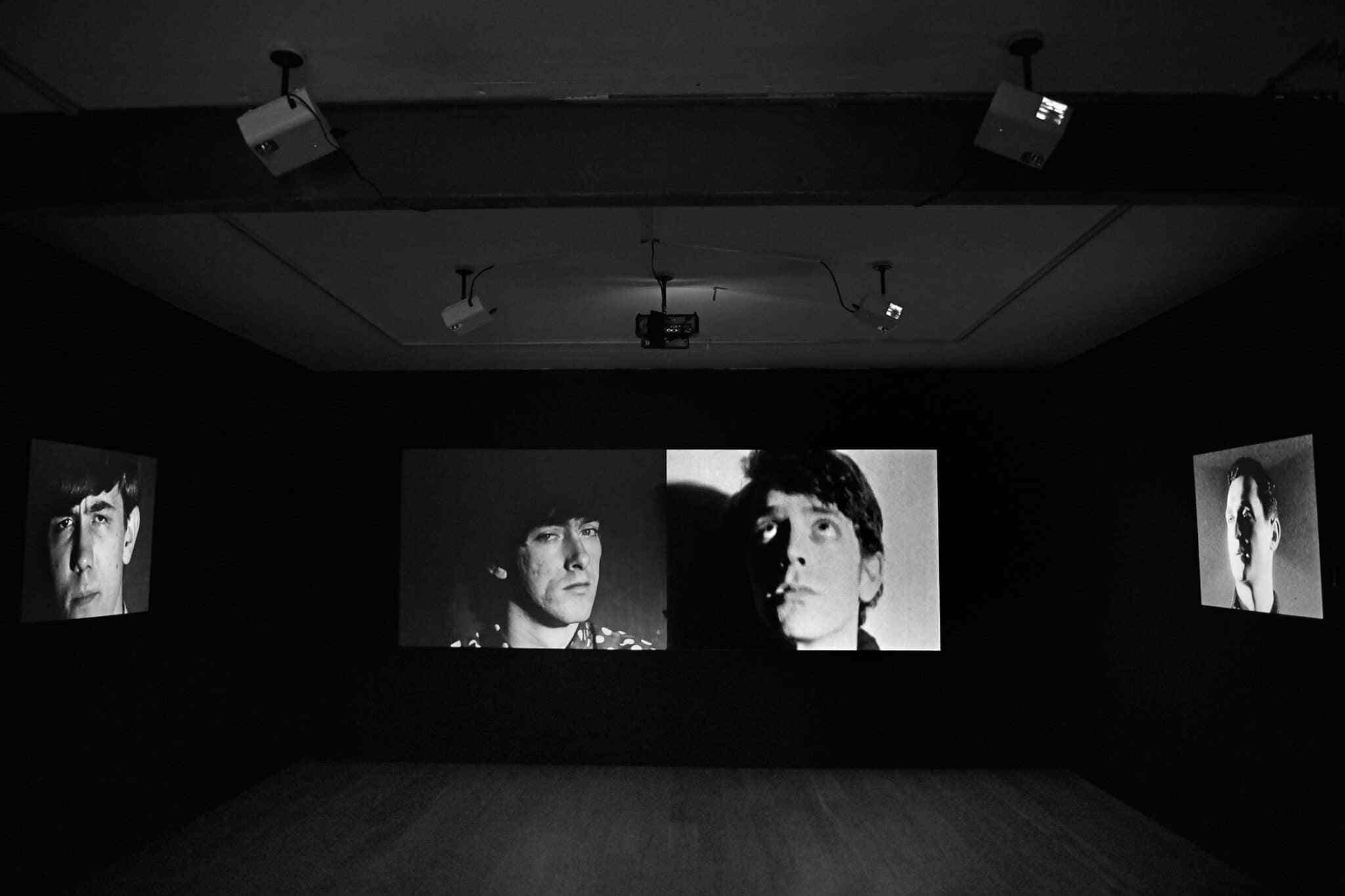
So when Venice fell through, New York was already planned. And so then New York was planned, and we had a big exhibition with the Warhol Museum, and it was actually the first public exhibition of the Warhol screen tests in New York. And it was the first time that these were available to see for free.
JC: Yeah.
KI: And the last time that they had been exhibited was at MoMA in 2013.
JC: Wow.
KI: So you realize that this glass ceiling is also really breakable because it’s kind of like there is no rule of like, oh, you need to be a this to do a this. So I think that that was really interesting.
And then after the museum kind of had big issues, and so there was a lot of moving around of management and all this kind of stuff like this. And when I called back a year and a half later because I let them fire people, hire people, do their whole thing, I went, and I said, hey, I have an idea for a new exhibition. We’re going to do a show centered around the film Outer and Inner Space.
And they were like, oh, cool. And I think that’s another thing. You have to be a little bit of a nerd about what it is so that you can know what to ask for and be like, oh, wow, they know this one? That’s an obscure one, like 1966. Right? And then you’re like, all right, cool.
And then it was cool because they were like, we don’t really do these collaborations anymore with galleries, but we do actually see in our files that we’ve worked with you before and you’re one of the legacy galleries like this. And I was like, yeah, you know, that’s true. I had a good relationship with Greg. Too bad he’s not here, but we can pick that up where whoever is not doing it.
And so then you go and start doing this again. And then what I realized is that what I didn’t do the first time was leverage the fact that we had the museum on board to get other objects and other things there. So this time I was like, okay, cool, let’s go and get things. And I was able to borrow things from the Castelli collection and get some other larger photographers and artists involved and stuff like this.
But all this to say, basically, people put all of these kind of barriers and say that, oh, you need to do this to do this, you need to do this to do this. At the end of the day, even another project that Ryan was a part of, which I think is really interesting, was the project that we did with my first gallery at Apostrophe NYC. And it was a collection of exhibitions that we did with a group of artists, 12 artists, and the project was called Base 12.
And I remember very vividly the first meeting that we all had. I asked everyone, like, where do you all want to be showing? Like, ideal scenario, where are we showing? What are we going to do? And everyone was like, oh, wow, museums, definitely museums. Museums, museums. The Whitney just opened a new great space. Like, oh, these museums are great. And I was like, okay, cool, yeah.
And then instead of thinking like, oh, yeah, we have no way of actually showing in any of these museums, I thought about, well, how could we show in those museums and what would be possible in regards to like, making an exhibition in the place where the people wanted to have an exhibition.
So what we ended up doing was I went to the new location of the Whitney that had just opened at that time. And you do, like, kind of a reverse stakeout heist kind of thing like this. You go into the space, and you study it as if you were taking something out, but you’re going to put something in. So it’s like it was a combination of basically going through the space, studying where all the cameras are, studying where all the security and everything would be at what times and all this kind of stuff like this, and then reading up on the laws to make sure that when we do bring things in, we’re not technically breaking any of the laws.
So the way we were hanging the works wouldn’t be able to be considered vandalism, wouldn’t be able to be considered certain things, so that the most that we could be charged for would be public littering. Right. Which is — that’s cool. That’s a pretty calm one. Yeah, whatever.
JC: So was the worst of that, community service?
KI: At worst.
But we did it anyway. We went in, and we planned an exhibition, and we actually hung everything with suction cups. Was this because — and correct me if I’m wrong — Yeah, yeah. Is the Whitney a semi-public institution?
JC: I don’t know if it’s — I guess it’s private.
KI: It is. I mean I think it was actually interesting. The day that we decided to do it or where I realized our kind of opportunity security-wise, was every month they were doing like a free night and it was like Friday, first Friday of everything. Like everyone comes in for free.
So I knew that 90% of the staff would go to the front of the house. So we came in at 7 o’clock or whenever they opened the door. So we came in like at 6:30, all paid a little bit and like went, did, and then hung up all the work. And then at 7 o’clock everyone came in, and they saw all the work.
Well, I mean you still had to walk in with the work.
KI: We walked in with the work, yeah. They were all small pieces. It was actually interesting. If you know the size of a large paint stir stick, like the five-gallon paint stir stick.
JOSEPH: Oh, you mean the box.
KI: Yeah, yeah, yeah. So like at the time we had little to no resources, and I wanted everything to be framed because it’s like framing is like — That was another thing. That means ready to purchase. Framing is great. It’s kind of like, wow, it’s framed. It must be finished. It’s like, wow, that’s nice.
So the paintings were all the dimensions; the final dimensions were one paint stir stick by one paint stir stick by half a paint stir stick by half a paint stir stick. And that was it so that we could go and like everyone would go to the Home Depot and go grab a couple things and grab a couple things and then I made them all into frames. And so those were the dimensions of the pieces. So they were pretty small.
And then we did it at MoMA PS1. We did it at the Mart Breuer. By the time we did it at the Mart Breuer, they actually knew what was going on because there was a lot of publicity around these kinds of hangs. But that was an interesting one because it just kind of was another way of like, okay, if you don’t have a traditional route in, what can you do to break in?
JC: Yeah, I was going to say that at least in my experience with gallerists and such, where I feel like the gallery is trying to — I’m not saying this negatively or positively — but trying to take, because it’s already taking on such an enormous economic liability, trying to take on as little liability as possible in other facets, right? Whatever way that can happen, right?
And the fact that you as a gallerist would ask your artists, well, where do you want to be? And that not purely be, well, I’m going to go to all these galas at the Guggenheim and get good with these curators and go to all these various events that one needs to go to to shake hands and kiss babies. You chose instead, no, we’re going to do some completely guerrilla shit and just go in here and do this. It seems like antithetical to someone who has to pay commercial real estate money.
KI: I think this was actually one of the best parts of that project in that time was we were not — we did not have a storefront. So we did not have a gallery. So the gallery that I had had before then ended semi-dramatically. It was a gallery in an illegal nightclub, and it ended with me getting arrested, my brother getting arrested, and a notice on the door saying that we could be there.
I think that was another really fun one with just being really kind of dumb. If you’re dumb enough, it might just work because we opened this gallery and it was like a gallery in a nightclub, and we briefly looked into a liquor license. They never had this one before.
I looked into it, and thought, liquor license? That sounds complicated. That sounds like a lot of people working a lot of money. I don’t have any of those. Fuck this. Let’s build a wall, and then we’ll build a painting and the painting will slide up. But then there’ll be a frame around the painting so it looks like it’s just a hanging painting.
JC: This is feeling like Depression Never Speak Easy.
KI: Yeah, yeah. Oh, very, very. And so we had this, and then we’re like, how do we get into this room with this painting? It’s like Clue. And we’re like, oh, I’ll put a mirror, and the mirror will be right across from the bathroom so it’s very inconspicuous, this mirror. And so this mirror would open up, and you’d go into the bar, pull up the painting, serve all types of crazy drinks, and it was well, so we’d go, and we’d serve all stuff, and then when the cops would come, it would be like, shut the painting down, hide out in the bar.
And then if I could get out of the bar before the cops came in, then I’d walk around and be like, hey, yeah, I don’t know, let’s just hang in here, art show. And you guys certainly thought you were about to get caught.
JC: No, so we didn’t get caught, and then by the time we actually were gonna get caught, I went to some other friends that I knew and found a way to get the cops to work for us. So it was like then once you have that, then you could do anything. Then it was kind of like, we still had it for fun, the little like, choo, choo, choo, choo, choo. But then we’d have our cops, and then the cops would come, and then our cops would be like, and they’d leave.
And so that was also kind of a wild experience because imagine if you were like really dumb and like 21, maybe 22, and you had the cops working for you and you could do fucking anything and we were working with like, I don’t know, all the local, all this kind of crap.
KI: All the local players. All the local players were part of it. And then it was also really interesting because they also knew; they had never had a situation like this where it was like, wait, you’re telling me that you’re bringing the clientele that we want to be selling to right into this building and this will never get raided because it’s protected? That’s crazy. How do you lose your friends like these, right? You know, this was great. And it was also, it was like a lot of crazy stuff started happening there.
But I think that’s another really fun one because I do think that one of the other big components of that was music, and music is another art form, and it’s an art form that’s consistently in popular culture. So I think that it’s really exciting to have like music and art in those same spaces because a lot of folks that know music will then get introduced to art, and you kind of come into appreciating and being introduced to visual art through another art form that you’re already excited about. And so that was always, like, part of that was really fun. That was like a really cool kind of collaboration of the two, and it would bring in so many other folks that wouldn’t come to a gallery exhibition.
They wouldn’t come to an art show, but they would come to a big party.
JC: Yeah, yeah. I mean, you know, and I mean, in theory, that’s what the gallery opening is like as an economic tool, you know? That’s not so old, huh? To open a gallery to make money?
KI: No, no, not that, man. No, because that’s a terrible, if anyone’s planning on opening a gallery to make money, I would immediately say that’s a horrible idea.
JC: Well, that’s like, that’s the mean of the conversation. That’s the median, if it was a number, the median number of the conversation. But what I mean is, is that, you know, like, and this has been my impression from afar of your gallery as an outsider to it is, you know, first to Amani, you know, friend of the show, Amani Fela, and then to Ryan, which is that, you know, yeah, Ki Smith will have a show, but Ki Smith will also have like a fucking performance happening or something to like bring in more people.
Whereas I feel like, you know, your, you know, what’s the nomenclature you’re using now? Like a middle-emerging gallery or whatever would not dare to do that because they’re emulating spaces that do not need to do that. So to them, ethically, you know, the notion of even having, let’s say, music play while these very serious collectors are viewing the art is a hindrance. You know, we would rather do something like spray pheromones than, you know, get in front of people when they’re quiet, and they’re whining.
KI: I totally agree with that. I mean, I think that there are a lot of folks that think that you need a certain environment to be taken seriously. And I think that one of the kind of fun parts about it is because I’m not as concerned with the art world and stuff like this, you won’t be taken seriously until you are, and then everyone will want to be part of the hang. So it’s like you just kind of like have to keep on doing and making, and there will be a moment where everyone’s like, oh, no, no, no. Oh, yeah, I want to be on the inside. I want to be part of this. Like, oh, this person’s doing this. I want to do this. So it’s like you kind of have to not be as concerned with like this.
And that’s another thing that even I’ve gotten internal flack from is like even with the artist programming and like what we’re showing because I do think that a lot of galleries at most levels except for what I would consider the very top tier, the blue chip ones like this, they show a specific type of work and they focus in this area with a specific prestige. That’s exactly right.
JC: They say, “we’re showing this type of work”, and “we’re showing work by these artists, and there’s some thematic overlap that’s probably fairly general, but it’s going to encompass everyone”. I feel like the encompassing you’re talking about is that we already have an established market figure for this, so we know. We know what’s going on here, and we know that if we have this client and these two artists in the same hang, we could then pull from this clientele into this clientele, and introduce this artist. If we show Philip Guston, we can show this artist. If we show this figurative painter, we can show Sasha Gordon.
KI: Totally. And so I think that that’s smart. That’s going and saying, hey, we’re building a clientele. We’re going to build this up, and then we will have clients for this type of work.
I think for a couple of reasons. One, because it’s a kind of a continuous puzzle of like, where are the clients? Who are they? Who are these people? You know what I mean? And then you do sometimes realize like, oh, no, they are sitting among us. They are here.
But then it’s a very elusive thing where if you’re trying to cater just to this client, this client, this client, what, do you know the client? Oh, no, no, no. You know art collectors. Okay, but who are those? You know what I mean?
And I think that what we ended up doing at the gallery is I have an initial theory of like, okay, we got to diversify like the large galleries so that we have the foundation to build up to that place. Now I have kind of a new theory that I’m working on: having three segments to the gallery, and you have all of them that will be performing in theory doing different parts to leverage yourself up to being at the top of it. Because the goal in general is to be at the top. You want to be the best.
And then how do you go and like get there? Because, like, right now we’re like here. There’s a lot of space between. And then you want to try to figure out, okay, so how do we get these clients? How do we get this interest? How do we get the social capital to continue moving forward and moving up?
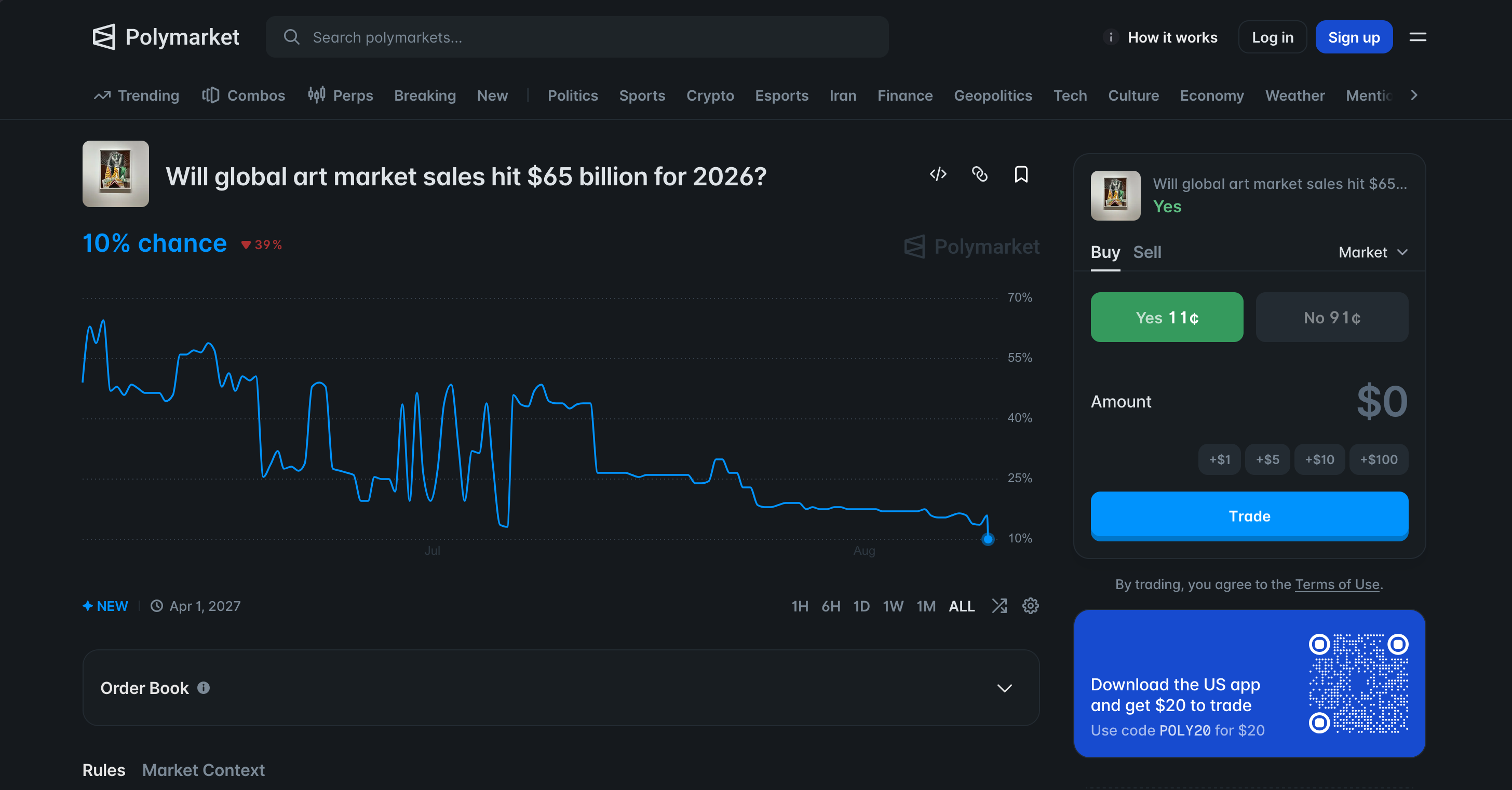
JC: Well, a few things there. First, in response to where did all the collectors go, you know, Hito Steyerl on an episode of Josh Cittarella’s Doom Scroll theorized that after the big art collector boom — the PUA boom, as I call it, of collectors buying emergent art — she believes that that money is now being parked in prediction markets.
KI: Interesting. I mean, I think two things on and around that would be, okay, when we were kind of starting things out, you kind of make this assumption that, oh, anyone with any, what you would call wealth, which was definitely a lower number than I would call now, oh, they must be collectors. And then, no, no, no.
What makes a collector is that Venn diagram, that intersection of interest in culture and affluence. Right. So, expendable income.
JC: Right.
KI: And so, I think that that’s really important where it’s like, I used to believe, oh, anyone with expendable income, well, they must be buying art. Right. That’s not true. It hasn’t been true ever. And then, but then you do find there are moments in history where demographics of folks that are typically not in that culture kind of bit do come into it. The last time that it was, seriously, was in the 1980s; you did have a moment where like stockbrokers and folks from New York finance were parking money into the arts.
JC: Also sanctioned foreign money.
KI: Totally. And I think that the interesting thing is that almost every time folks that are typically not buying works get in, what ends up happening is there’s a boom and then a bit of a crash and then everyone’s like, oh my God, that was a terrible idea. Jinkies. That was horrible. Like for example, in the 1980s, even like Japan started buying a lot of art nationally and they would invest a lot in emerging work and then there was the big crash. Then the last decade happened. Big crash happened in the markets and everything like this and they realized that what they were buying was garbage.
JC: Right. So they hadn’t bought the right people that were hot in the hang.
KI: Right. And it’s not that dissimilar to not go down this rabbit hole in any way, but like to even the NFT kind of scene like this. There’s a lot of folks going into a new market, being built, made like this. A lot of people pumping a lot of money into it and then there’s no sustainability there.
Like if you go in, like, I think in general, this is probably a little bit of a controversial thing to say.
JC: Oh, please say it.
KI: Most art does not work like typical commodities.
JC: Oh yeah?
KI: And art, you know, art’s value is not derived in the same way through supply and demand as other commodities.
JC: Get out of here, Ki Smith.
KI: Yeah, I know. That’s a great thought. But then basically, if you create the fictional kind of supply, demand, all those kinds of things like this, you really can manipulate — manipulate is probably the wrong word — but influence the market in major ways. And so I think what’s really fascinating is that idea, and I believe in this, there is no ceiling because you are essentially working with alchemists.
JC: Yeah.
KI: Right? So it’s like you’re working with these mythical creatures that can take materials, materials that are worth nothing at times. They put them through this process, and on the other side of that material, that process is a different value. And so that idea of like, you know, this is just a bunch of wood and paint. Material value, very low. It’s been put through this process, and on the other side of that, there is value.
JC: Right.
KI: And then when you start buying, you know, when a saturation of clients decide to get behind something, that value can start moving and moving upwards.
I think that another big thing about this is kind of a tangent. Still, museums and stuff are great because then that means that those works are there, they’re purchased, and they’ll never be sold because I think what's more detrimental to building the value of art is the idea that then clients can start participating in that market and dumping. Then it’s very hard to control.
JC: Well, that’s sort of what I was getting at about like Steyerl’s point about prediction markets, right, which like prediction markets operate the same kind of way.
And I mean, go ahead guys. If anyone from New Jersey and anyone hears this, sue me. I don’t care. I don’t have any money.

But, you know, like let’s take the case of Anna Weyant, right? Gagosian’s girlfriend, you know, she gets out of RISD, you know, immediately starts selling paintings for one, two million, which is really just Gagosian like sharing it with his buddies who have the money to make it whole. Then it goes to the secondary market and does what it does, right?
You know, and that’s a statement aside, but connected to this question I want to ask you, and I’ll give some more context for this. You know, people that I’ve certainly been in business with, or I’ve even orbited on some level, you know, shook hands with or whatever, you know, some of those movers and shakers and workers have told me in not so many words that all this industry cares about is money, right?
And I think, to your point, and I think to the points that you were making previously, you know, that was a delusion of the corporate world that came into the art world, of the corporate and private equity world that came into the art world and by the time we were post or some would say still knee deep in the zombie formalist situation, you know, we’ve reached this point where, yeah, or reached the point, reached the peak, if you will, of where people were saying, okay, like, if this place is saying that this has prestige and this is worth buying, like, I’m gonna buy it.
But also, you know, said place establishing prestige maybe is selling the work to, you know, conglomerate private equity to create the sub-economic strata of lobby art or they are, you know, selling it to, like you said, people who just have money, who just want nice things, which is what we’ve seen with, I mentioned Monopoly earlier, you mentioned NFT, we can even say Brian Donnelly or Cause was a part of this phenomenon or Hebrew Brantley today, you know, where, and all those things might be cool, might have some sort of cultural merit in wherever it is, but, you know, the arena we’re talking about was supposed to be an established triumvirate of artistic action and creation, institutional leanings and, you know, gallery economics was making a sort of, like, model that causes culture to move forward.
But I feel like what you’re alluding to is more so of a, you know, something that I think about all the time, which is how does anyone expect, and we can take it outside of art, but how does anyone expect an industry that is based off of ephemerality to actually create substantial income, right?
But that said, you know, the Art Basel report this year documented the middle market collapsing down 29% since 2010 while the top concentrates further. You know, you’re running a gallery inside that contraction. You know, what does it cost for you to keep that space open? Not just financially, but what’s the mental stress of that, if there is?
What is the, you know, it doesn’t sound like there really is because it seems like you’re really committed to operating a different way, but I’ve been curious about that.
KI: I mean, I’ve always believed that the, even investment-wise and everything-wise, that middle market of kind of, I would say, between 20 and 100, that is the most fragile market in art. That is like, that is where I would consider is no man’s land where it’s kind of like you are past the client that would buy this without knowing what they’re buying or without caring what they’re buying, without just the, oh, that looks nice over the couch, or oh, that’s cool. I like this. This is something that I feel like this artist has a little steam behind them. This is a cool thing like this. Then you’re into the, oh, this has prestige. This could move into the millions and millions of dollars.
But that actual step is quite difficult. The gatekeepers on the other side of that step are protecting their assets and protecting their markets. I think that that gets a little bit tricky.
It is a necessary step for an artist to kind of go from this, what I would consider the under 20, the kind of five to 10 range, like this where all of this work is and where a lot of the works that we work with are.
When you get into that next phase, it’s a really interesting kind of arena of things where you are working with artists that now have been in a few things and some museum this and have had, you know, are in X person’s collection but have not had the, I would say the auction backing and the major kind of client backing to then take it to that next place.
They don’t have a champion. They don’t have a champion, and their champions are obscure. So I think that it’s kind of like, I have a couple kind of theories on that or like what we’re doing to bridge these markets and stuff like this.
I would say there’s, okay, one section of the gallery; there are three sections of the gallery that we’re working with right now. And one section is this type of work, works like Ryan, works like Luke over there, works like other folks that we’ve worked with for a long time. For lack of a better phrase, the middle class. No, they’re the lower class. The working class. The working class. I’m not going to lie to y’all. The working class.
This is the class of folks that, on the darker side, have the farthest journey to go to reach the promised land. However. But I will say this: I believe, and I still believe, that this demographic actually has obviously the most room to grow. I think history is on their side. Right. And they’re the only artists that you can currently right now buy for like four grand or like a drawing for a couple grand.
And it’s like, and also for context, I just want to add this. I like where you’re going with this. You were right. Rauschenberg once sold a bunch of work to a bunch of galleries for 500 USD in his time. Which, like, the equivalent of that I don’t even think is breaking 10K today. So just so we know, none of these guys, like Rauschenberg, died broke. None of these guys are making money. Please.
And I think that’s really kind of important because there is that much growth. And these are the, I don’t know if you ever walk around the neighborhood or in the east village. I grew up in the east village. There’s a lot of folks that are there and there are these older heads in the neighborhood. Some of them you can tell they did well and some of them you can tell they didn’t do well. But then they all have these stories of like, yeah, you know, I was at an opening and Basquiat tried to sell me a painting for 100 bucks and he spilled my drink and I told him to fuck off.
There was that, right? And that story, walk around the east village, you’ll hear like five versions of that story. And then with varying artists. It could be like keep varying. And then you’ll hear some of the ones that were like, oh, yeah, no, I bought this painting for 300 bucks and then sold it a couple years ago and bought a house. So there’s that story there too.
And then there’s the story of like, I bought it back then for 100 bucks and then, yeah, but then my car broke down in the 90s and I sold it for a thousand bucks. I know that story too. So I think that it’s really interesting. I would say as an asset class, art as an asset class would be a very illiquid asset that has high potential and you need to do research before selling and it would be the last asset that I would sell if you ever needed a quick buck.
It would be a very illiquid asset that has high research selling and it would be a very illiquid asset that has high potential and do research before, and it would be a very illiquid asset that has high research. And so, you know, that’s one of those, like, and I think it also happens a lot, like, you know, I could see a world where, you know, buy this piece, right? You buy it for four grand.
And then, you know, ten years later, obviously things are doing really well, Ryan’s having a little moment like this, and you have the opportunity to sell this piece, and you have the opportunity to sell this piece for 80 grand. And you’re like, shit, that’s pretty fucking good. And then, you sell it. And then, in 30 years, your kids need to go to college, and you can’t sell your paintings. No, no, I’m kidding. Right.
But then, you see it on fucking Christie’s, and that shit goes for a million dollars, and you’re like, what the fuck? You know what I mean? It’s like, and I think that it’s like one of those things where I wouldn’t- I think art is one of the really exciting assets to purchase and enjoy, and to, you know, if you’re looking to go and make money, there are a lot of other markets to quote-unquote make money in.
JC: Yeah. But art has the highest ceiling. Like, there is no other commodity in the entire world that can go from like $4,000 to like $4 million. It’s like, it just doesn’t, it doesn’t happen. That I mean doesn’t just have that like, Flyers of Valkyries, like napalm strike kind of moment, you know.
And then I will say, But I was gonna add to your point though, and I would really love to get those two other sectors, but you know, I think at some point, things got distorted in a way, for much of the reason that I brought up earlier, in the sense of like, people began to look at art like they were looking at the buying and reselling of clothing industry. You know, and I’m not talking about the people who are actually going to the auction houses and shit. But also kind of them too, because I mean, when you have Virgil Abloh’s Game Warren sneakers going for as much as like a Cy Twombly, it distorts your idea of what is high and low culture.
Not to say that Virgil’s, that Virgil’s oeuvre was low culture. You know, it’s just different from what we’re talking about. But I say that to say, like, there was a time where, you know, I actually watched this really recently in preparation to talk to you, The American Friend, the film, which is the first talented Mr. Ripley, for those who haven’t seen, you know, where, you know, like, the whole movie is kind of about what you’re saying of like, oh, like, I’m the guy who’s like, essentially, the confidence man here. And I can set whatever it is that’s going to be, but it can’t be too much, can’t be too little. And I have to find a way to navigate so that I can re-up on whatever is going on, right?
And I mean, the reason I connected to like, sneaker reselling culture, specifically, is because that is the same bet that Nike made with like, Nike SB, right? Which was, oh, shit, like, we had this run, Orange Box to Black Box, made the Pee Wee Hermans, made the Hawaiis, made all these things. Now, we have the retro things that came out 10 years ago.
The equivalent of art would be, we have to formalize, let’s say, respectfully, respectfully, you know? And I mean, if you don’t feel respectful, just holler at me; we could talk in person, have a conversation about it. But that’s what has you making rain paintings or stuffed, or not even stuffed, metallic blow-up dogs for lobbies, right? You know? It’s that same idea of like, and I mean, we’re seeing this with the advent of like, of the new wealth in China, right? Or kind of the crescendo of new wealth in China, where you have, where you have Chinese collectors and some dilettantes going and just literally purchasing vast swaths of European and Asian and Asian-European, Asian-American art, and creating, and just creating their own museums. Just like, all right, we’re just gonna play Sims in this country and just like, make whatever we want, you know?
Whereas, meanwhile, in the U.S., we’re entering this stage that, like you mentioned with the Japanese lost decades, where the way that we even value art has already eroded to a point where the metric, that’s why I was so curious about what you were saying about the Whitney, where like, the metric itself is so tainted that we cannot properly ascribe value. At least that’s my feeling from what you’re saying.
I mean, I think that art has become incredibly niche.
KI: Really? I would beg to differ.
JC: Really? Yeah. Fine art? Yeah. I would beg to differ.
KI: You think that it’s becoming more like, kind of collectible and like, kind of like, chatty? Not that it’s becoming more collectible. If we’re talking about purely, like, purely collection, then I think you’re correct. But I think in the, I think there’s something that needs to happen with art to make it worth being collected, which is the cultural actions that are spurred from the art itself, right?
JC: Okay.
KI: And I think that like, we have reached a point where art has become so, quote unquote, ubiquitous that like, that, and so polarized, you know, that that conversation is becoming too atomized to really like, have a coherent trajectory.
I was saying this in the previous episode with Luke, which, you know, I was up way too late, just like, doom scrolling on my phone, and I come across this painter being auctioned by Sotheby’s, who his whole thing, apparently, at least how Sotheby’s wrote the copy, is that he makes these seemingly never-ending verdant landscapes wherein which football can go, can happen unencumbered by nation state or by the oligarchies of today, you know? And it’s really just him taking this large squeegee and doing, like, his best Gerhard Richter impression, but with one color and one material, and then painting little tennis figures in it. And I just had to say, and you might know this artist- well, you might know who I’m about to bring up next.
It seemed like the crescendo, but also the continuation of a trend I saw with artists such as Tyrell Winston, where, like, we had moved beyond, like, conceptualism had become too difficult to sell for the new emerging collectors, so the concept had to be basically a one-note joke, which is like, oh, I’m giving you the tightly deflated basketball. It’s David Hammons, but it’s white, you know?
Oh, oh, oh, I’m going to do the Mickey Mantle signature forgeries, because that oligarch who could never get an original Mickey Mantle sculpture, I mean, I’m writing on signature, I can now get that, and it’s conceptual, because the artist is just commenting on the economics of that existing, right?
Whereas, like, even that simple concept got stripped from things, where, you know, you see in the fall of Clearing, right? You see in the fall of, whether it be Lyles and King, or fucking, like, a lot of these other guys, what Jack Shaman is going through right now, what K.J. Freeman went through with Housing, you know, which is that, like, the line, like, they continuously say there is a line wherein which you’re either making sales, or you’re not, but that line continues to move and continues to be shaky, and it’s just resulting in, as you’re saying, an industry that really doesn’t make any sense, you know, or rather, an industry that, because everyone can make sense of it in their own way, there is no, there, again, like I was saying about, like, the aesthetics themselves, the metrics themselves are just not trustworthy enough.
In many ways, and again, this goes back to what Steyerl was saying, in the sense of, like, yeah, a prediction market would be smarter than art, because the artist, like, the —
KI: Well, there aren’t enough; I would say there aren’t enough metrics to make proper...
JC: But there is, though. Art logic exists, you know, art index exists. But if you think about it, there, if you want to go and try to, like, treat art like a normal, like a market, right, the amount of data points that you have, even if you’re entering data points, there’s not enough data points that you would be able to enter to go and make a conclusive analysis of anything. So, it would be impossible to say, oh, with the data set that we have of brand box sales like this, we know that this market is this, that, and the other; there are not enough data points.
And even with artists that have very robust markets, again, you’re talking about a few hundred, maybe a thousand data points, at best, over many, many years like that. It’s just like, there’s not- you can’t go and analyze and predict and treat something in that same way.
Like, what’s the true ROI on a piece, right, for maximum value, right?
JC: And then I also think value is a really interesting one, right, because value is what someone will pay and what someone will accept, right? So, it’s like, as a gallerist, I live in that kind of, like, liminal space of, what will you sell that for? What can I get someone else to buy that for? And that difference is where I live, right?
So, it’s like, and then I think it’s really interesting because when you get into larger numbers of things, people do start getting a little bit more freaked out about it. You know what I mean?
KI: It’s kind of like, there was a situation I had a couple years ago where someone said that they wanted to sell a collection of photographs, and I said, what do you want to sell it for? And he said, I want to sell it for a million dollars, and I was like, all right, sick. Like, what would be the split if we sold it for a million dollars? And he was like, I’ll do 60-40, and I was like, all right, cool.
And so, I offered it, and I was like, this guy already feels a little bit, like, shifty. So, I was like, you know what? I’m going to try to protect myself. I’m going to offer it to someone for 2 million, and then he can’t possibly be upset because the full amount would be what he gets, right? What could go wrong? It’s impossible.
And so, I offered it to someone at 2 million, and they said, oh, let me have my experts look it over, and they had their experts look it over, and they said, eh, nah, we’re going to pass. They’re like, if you want 2 million, I mean, how much does someone else want? We’re going to pass on that.
And then, I was sitting at the gallery one day, and someone walked in, and they were talking about a foreign client that was really looking for, like, things kind of like this. So, I said, oh, you know, I have this collection of photos, and it was photos of Basquiat. And I said, oh, I have this collection of photos of Basquiat, and he was like, oh, really? That sounds really interesting.
I was like, oh, interesting. Her interest level was higher than I thought. So, because her interest level was higher than I thought, and I was feeling myself that day, so I said, she was like, how much is it worth? I said, well, you know, I actually have a really good price on this. It’s 3 million.
And she was like, you know, so she went back to her client, and she said, you know, we have this incredible collection of, you know, very rare photos of Basquiat. There’s around 1,000 images in it. We’d have the original negatives, and blah, blah, blah. And the client said, yeah, great. Let’s do it.
And I was like, cool. So, I called up an art lawyer that I knew. I said, let’s draw up some contracts, make some things. So, I made a sales agreement, all this kind of stuff like this, and, you know, spent money on his retainer, all this fucking legal bullshit, which, if now, I would have done that shit with Chachi, you know. But, anyway, so I’m in the hole a couple grand.
And then, the client comes back, and he signs it. He said, yeah, I’ll transfer the 3 million over. So, the only signature we need now is the artist saying that, here we go. So, I go back to the artist, and I say, hey, we got it. I got it. Not only did we get it. We did it, Joe. We did it at the tune of you will be walking away with double what you asked. Originally.
He said, oh, no, this is my life’s work. No, you can’t be making that off of this. You can’t. No, no, no. That’s unfair. Oh, this is my whole life. It’s all right. It’s all right. I’m not a greedy guy. What do you think is fair? Oh, the most I could do is, like, maybe give you 20% of this. That’s all right. That’s cool. Just sign over there.
Oh, no, I got to look over this document. I got to get my lawyer involved in this. No, no, no, no, no, bro. It’s really simple. You’re going to give the negatives and the rights to the images. So if they want to fucking put them on mugs in Korea, they can put them on fucking mugs in Korea. Oh, I don’t know. I don’t know.
Long story short, this guy drew this shit out for fucking six weeks. It was a dark six weeks of my life. You never want to be like six weeks, and every day you think that you’re going to be a millionaire the next day. You’re like, oh. But tomorrow I’m going to be a millionaire.
So what ended up happening is, obviously, he fucked everything up. And eventually the client, after six weeks, said, you know, it’s okay. It seems a little bit crazy. I’m going to pass.
But the interesting thing is, like, that value of, like, 1 million. 2 million was a no. But 3 million was a yeah. So it just paints that story of how interesting it is to have people, you know, once money is involved, what someone will pay is semi-arbitrary. What someone will accept is semi-arbitrary. And I think that a lot of the time it’s also people speaking in numbers that they don’t understand the value or meaning of.
So it’s like, you came in, and it’s like, a million dollars. With a million dollars, I’d be a millionaire. And then you’re like, all right, cool. But then when actually push came to shove, it was like, ah, right?
So there was another kind of moment, smaller numbers, but where I saw someone make a quote on something that was way undervalued. And they had asked me if I would sell it or help them sell it. Well, I asked them if I could help them sell it. And they were like, yeah, that would be cool. That would be awesome. And I’d be like, yeah, yeah, yeah, great. And they quoted me the number, and the number was low. The number was in the kind of like four- or five figure hang.
And I’m sitting in my mind, I’m like, they’re talking four or five figures. And I believe the value of this is in the six or seven. So instead of going and agreeing to like, oh, yeah, I’ll do it for like 20% or 30%, this, that, and the other, I was just like, you know what? I learned my lesson over there. I’m going to buy it. I’m going to buy it.
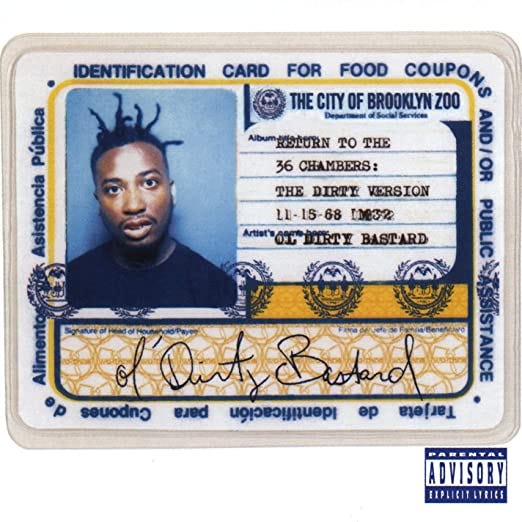
So I bought it. And I ended up buying the- do you know Wu-Tang Clan? Do you know the Wu-Tang Clan? Do you know the Old Dirty Bastard, ODB? Razor’s on Tom. And his first record, Return to the 36 Chambers, which is, in my mind, arguably the most important piece of the 20th century, for sure. The most important. This is like top, top, in my mind, of hip-hop records. It’s like Jackson Pollock rapping. Right. This is crazy.
So what ended up happening is, so I ended up buying the original card that they shot for the album. The EBT card, I believe he’s talking about. Yeah, this is the original card that Elektra Records made to shoot for the album. And if you know that album or Google it later, Return to the 36 Chambers, it’s a picture of a card on a white background with a little parental advisory sticker on it. And that’s the whole album. So it is like, for all intents and purposes, the album.
And so I bought it. I had her do the authentication. It was the former creative director of Elektra Records, so very good pro-finance, very good source. It wasn’t like some person I met in East Village. And I went over to Luke’s lobby. And his wife is a notary and a lawyer. And I bought it in cash in the lobby.
And then you’ve got to kind of do things for the value. So then I hit up my friend. I was just having drinks with Ramoa. Do you know the suitcase company? It’s like a bougie suitcase company. They make nice suitcases. And I was like, you know, it’s going to be hard for me to sell this four-inch by five-inch object for more than, I think, just at the object, more than a few hundred grand.
And I was like, but I want it to be more. So I did a collaboration with Ramoa, and they made a custom case. So it’s beautiful. And now I’m trying to work with Iconic Artist Group to get the surviving members of the Wu-Tang to sign around this mat and all this kind of thing like this. Because it is my belief, with the signed thing, with the case, with the whatever stuff like this, I’m offering it at $1.36 million. And I think that that’s the true value. For the 36 chambers.
JOSEPH: But I think it’s kind of interesting, right? Because it’s only worth that if someone decides that it’s worth that.
KI: So I’m going to keep on building things up to go. But for now, the value is still where I bought it. Until I can sell it for more, the value sits there.
But I think where a lot of dealers and stuff, like you were saying with Castelli buying all the Rauschenbergs and stuff like this, that’s where what I realized from reading things, listening to stories and different things like this, that’s where real value is made. And that’s actually something that a partner at Zwirner once told me. You don’t make money selling art. You make money buying art. And reselling it if you ever want to resell it.
And then I saw his collection of art, and I was like, yeah, that makes sense.
And I mean, it’s akin to, like, the labels are extracting money in this case, but it’s akin to current music, especially in rap, right? Where it’s like, alright, a SoundCloud rapper can be completely broke, baby comes in, buys him a Lambo, buys him a chain, all of a sudden his value is here, right? Whereas just yesterday the value was at the floor, right?
And art exists in that same way where, or maybe even opposite to it, where someone established in the marketplace can purchase something of someone and completely ostracize them out of it, completely cut them out of it by saying they’re difficult to work with or they’re whatever they are and continue to catapult and create value with their work.
JC: Now, you know, I think that everything you’re saying, I believe in theory, we’ll see on the playback how I feel about this, but everything you’re saying, as I hear it in situ, I agree with you, but I am curious if not only artists, but non-financial liability holders in this industry acknowledge any of what you just said, whether it be curators, whether it be art advisors, who are in many ways supposed to be the day traders of the art world, or obviously the artists themselves, or the writers or anyone existing.
It seems like, and maybe some of this is because of war-gaming, the inherent war-gaming that happens between gallerists and artists, but it seems like, if you talk to the typical artist or, I guess, the working class artists, as you put it, even the, I guess we’ll call it the mid-level management artists, I’m gonna write that one in on myself to get you moving on that one.
It appears that they believe that people like you believe that unless they can inflate their value in some way that you just said is not even possible for them to do, that they will be valued and placed and positioned in the right space. Do you think that to be true, or is that just something...
For lack of a better phrase, these niggas are lost, and they don’t fuckin’ like...
KI: Which ones?
JC: The artists. Everyone but the gallerists.
KI: No, no, okay, so I would say yes, but I would also include the gallerists in that, so it’s like, I think that everyone is lost, and everyone is trying to figure out what the value is, what is going on. But you just said yourself that the gallerists and collectors are setting the value. The gallerist is the authority on it, so when I say this...
JC: How can you be lost if you’re an authority?
KI: This is kind of like a little bit of the secret to the whole hang; this is kind of like a little bit of the secret to the whole hang, but it’s self-proclaimed authority. And I realized very early on that’s why I opened a gallery, because I realized by having this storefront, you are the authority, and you get to make the rules. You make the rules of that box.
I think, and therefore I am. Because the box has your name on it. I went down to Descartes and bought a coffee, and that’s pretty much it.
Because you become this authority, then you do become the expert. If you want to be seen as the expert, then you have to go and do a little bit of the research to be the expert in that field. Be able to make people feel comfortable that you are in fact the expert.
I think it is interesting where all of a sudden it starts with I’m self-proclaimed, and then through getting further down and through the persistence and patience of trying to achieve something, you actually then do become the expert of that field. So it’s kind of like initially you are faking it, and everyone is faking it. It’s very tricky to know when that tipping point is, but at some point you do become the expert of that field. You do become the kind of people that someone will go to to go and, oh, I need to go sell my this. I want you to go and help me with this. The track record just begins to speak.
I think it’s also a lot about saying you want to be signaling to some folks that you’re doing these things and a lot of these things. You want to signal to other folks that you’re not doing any of these things. You do become a very kind of like in the arts, I would say the arts is one of the only industries where one night you could be in one demographic circle. The next night you could be in a completely different demographic circle, and you have to be able to move naturally in both circles.
You have to be able to socially navigate. One day you’re over here. One day you’re over here. That’s cool.
JC: I know for certain the curators, the art advisors, and let’s say the mid-tier to successfully moving emerging artists do as well, but that is still an extreme minority of the so-called art world ad nauseum, right?
The vast majority of people, it seems like at least from what I see that they are playing a sort of like schadenfreude kind of like weird mirror game on themselves. They want to see, well, it’s interesting because certain people want to see you as successful and certain people, and sometimes you aren’t.
There was one example of this which I found very funny one day. I was going into, and this is kind of like partially my own issues of pride and then partially my wanting to signal certain things like this. I went to Chicago to pick up some artworks of an artist. The only way to get this show back was to go, and I calculated that the money that I’d spend on gas and the van would be the best way to move this all through.
At the same time, while I was in Chicago, I was connecting with a friend of mine that I also wanted to signal that things are popping out here. It was interesting because I went there and didn’t actually have a place to stay. My friend that I went with, the artist, he was staying at some friend’s house, and he was like, oh yeah, where are you going to stay? I was like, yeah, I’m good, I’m good.
Then I ended up finding a random parking spot and sleeping in the van outside of this Michelin-star restaurant that I then woke up to, went to breakfast with my friend at this crazy restaurant like this. She was like, oh, where were you staying?
I had Googled a nice hotel around the corner so I could be like, I was staying at the da-da-da-da-da. Then you go and do this and like, whatever, cool, great, little thing. It’s kind of a little bit sometimes that hang of you gotta go and be like, oh, I’m doing this.
Then I told my other friend, because I didn’t want him to feel bad, so I Googled a not-so-nice hotel and told him that I stayed there. The Holiday Inn in Chicago- I stayed there.
But it’s like, but I think that’s kind of like... But I do think that it’s kind of like that’s a nice illustration of kind of like hanging in certain things like this, right? But then also that idea of like artists and people in the arts industry, you have to be willing to do a certain amount of the hecticness to be able to have an opportunity to go and make it out of that, right?
It is constantly in this kind of like, this fake it till you make it kind of hang like this, knowing this, all this kind of crap like that. But another thing that I’m always trying to do is think about, because when I was little, my grandfather, who’s an artist, he told me that dealers are like art dealers are like one step above drug dealers. They’re really like the worst people.
And so when I was younger, I was trying my hand at drug dealing, and then it was able to leverage that into art dealing. And then I’ve always thought about art dealing as like, how can you do that in a way that it’s good? In the way that you don’t go to jail, white collar or otherwise, because, like, and I think it’s really interesting because you do want to kind of be able to be good to the artist and good to the folks that you work with, good to the clients.
And how do you do that? Because sometimes it is like, there’s the artist on one side and the client on the other, and you are that bridge between, and so you have to be able to figure out how you can morally and business-wise make that connection happen.
JC: I mean, it’s sort of a realpolitik, but of economics.
This actually leads to like, two questions. Two more questions, then I’ll get you out of here. So I can do my close read. You know, one, I mean, I mentioned earlier, you know, all these mid-tier to even like, mid-tier galleries closing, such as Lyle’s & King, Jack Shaman, Clearing, who had the veneer of a large-scale gallery, what was a mid-tier gallery. And the contraction of actual large galleries, such as Pace, which has seemingly dropped more artists than Atlantic Records has.
And you know, I just wonder, with that being said, I wonder, for folks like you who see that happening, or actually before I get to that, I want to say this, you know, in that destruction or market correction, as people with MBAs would say, you know, the typical things are happening that these same gallerists laughed at and jeered, lesser-equipped outfits for the warehousing of art, the disappearance of art, the consolidation, i.e., purchasing of art by other, by larger entities, which is not really spoken about amongst gallerists, you know, and with that, things that should normally leave people either financially or criminally and or both liable, you know.
So that’s one thought, just for everything that you’re saying, and I guess the question I have attached to that is, you know, are we on the precipice of just some gigantic, like, you know, like the Bronx is burning moment with galleries, or is it just like a slow crawl to basically a new market model needing to emerge? That’s one. And two, and just second, you know, whichever way your answer goes with that, what do you see if there is any viability for the artist and the mid-level management that has tethered themselves to said industry in, say, the immediate to coming future?
KI: I’d say two things. One, with all of this stuff happening and larger galleries contracting and mid-scale galleries closing and stuff like this, I think that instead of being afraid of the kind of this market correction, because we are not in either of those lanes, this is really exciting. This is great. Make some space. Make some space.
And I think that really the best things happen when there is an out of collapse. You know, I think that even one of the things we said... I was like, fuck yeah. This is great. Because all of a sudden there is more space, and I think it’s kind of like, you know, when even the first gallery that we had shut and everything like this, I think we wrote somewhere it was like a phoenix from the fucking fire is going to rise from the fucking flames, and you just make something out of it.
So I really believe that this market correction of sorts, because I wasn’t participating in either of those markets, is the most exciting thing that has happened. And I think that’s great. I think it’s really wonderful. It’s making some nice space for us to come in and do. And to also create a new model, right? And create something that is bringing more excitement around and bringing folks that are not interested in the visual arts into the visual arts.
I think that’s always the most exciting part. And that’s even one of the parts of the program that we’ve started to incorporate into the gallery is working with music and that intersection of visual art and music. Museum of music and art.
JC: Like what the MOMA PS1 says it is. That’s an ad. PS1, give me the bag. That’s an ad.
KI: Come on, guys. I do think at some point getting into museums, this is the tangent now, is great. I feel like we need a show. Like maybe three years ago I bought the domain for the New York Museum. Oh, yeah, we don’t have that. The New York Museum. In a city near you.
But no, no, no. I do think that market correction is great. Awesome. Let’s make some things happen. Let’s move. I think if you’re following that traditional path, that’s really scary. And if you’re one of the galleries that is where your peer is closing, that’s really scary.
These are not our peers. And I think that we really belong in a very strange area right now where there’s definitely folks that see us as- I think there’s folks that literally see my gallery as every single, the lowest tier, the middle tier, the high tier. It’s a little bit confusing, and I’ll meet people that are like, oh, wow, that’s crazy.
And then I’ll meet people like, oh, that’s a small little kitty gallery. And it’s great. You don’t need to fall neatly into one of those boxes to run a program. And I think that you can go and do collabs. I think collaboration is really important on every level.
Whether you’re collaborating with what we’re calling the working-class artists like this. Or whether you’re collaborating with folks that people get really fucking excited about and have huge fan bases. We’re going to do a collaboration with Blondie in February. And a couple of days ago, I didn’t even know that this was going to happen, but a couple of days ago I had a nice chat with Maxim from, do you know the group The Prodigy? Said now we’re going to collaborate with The Prodigy in September.
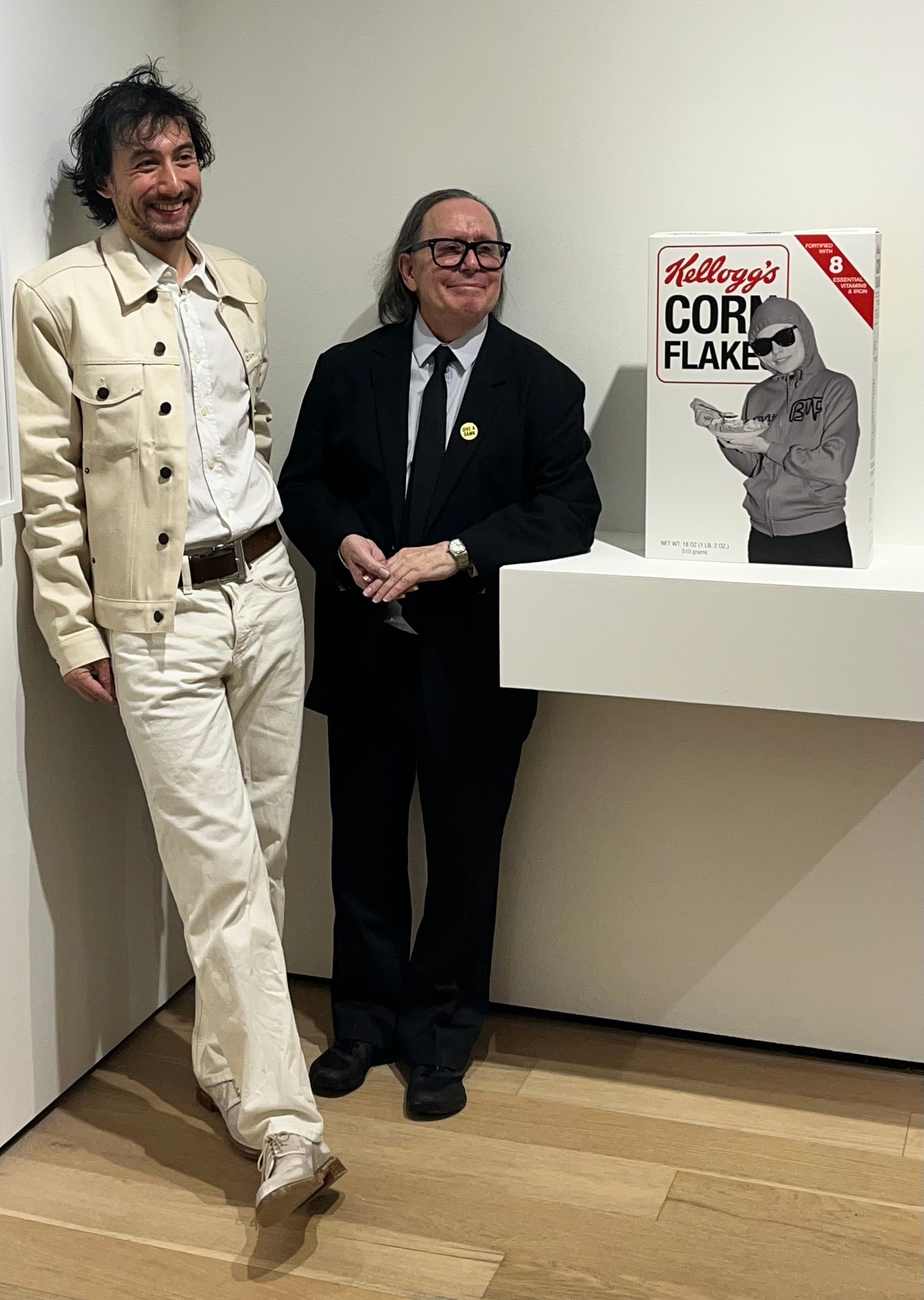
So it’s like, yeah. And shout out, these are all things that are possible because of the community. And because of the community that we’ve built around the gallery and personal relationships and stuff like this that you build. And I think both of those shows are examples of bringing in programming that has a built-in fan base and then introducing them to the gallery, to art, to your program.
And so I think that we’ve done a lot of that where it’s like leveraging built-in audiences and built-in fan bases to give exposure to the gallery. We did a collaboration with Punk Magazine in December, and it was the 50th anniversary of Punk Magazine and that’s actually now gone on and we were able to collaborate, and now that show is at Mass MoCA. Got some legs.
So this is interesting because we’re working with John Holmstrom, who was the creator of Punk Magazine. Legs was a co-creator who was one of the writers and stuff like this. John and Legs aren’t friends like that, and you do realize that all the personal dramas between different things like this. So it’s like we’re working with the John side, and then there’s the Legs camp. And a lot of these people are in both camps. I put myself into John’s camp, and we’ve gone, and this is actually traveling. It’s at Mass MoCA now. It’s going to Hudson Hall in Hudson and we’ve gotten a lot of museum traction with this.
And it’s really interesting because if you were to tell me that this would be the first show that we’d get into Mass MoCA that has gone through the gallery, I would have been kind of surprised. But you find the avenue to be able to do that and you find those collaborations.
So it’s like when I did that show I realized like, oh if we make the silkscreens with all of these artists at the studio that’s in Mass MoCA, I will get in line to go get connected with these folks, and then we’ll be able to actually get into there. And that’s what happened, which was great.
It is one of those things where every win you have to leverage and use as a tool to get a bigger win. And get another win.
And so it’s like yeah I mean when we were younger and stuff like this I think there was definitely something where it’s like oh people want to buy things because they feel really bad and they feel really bad like oh you’re doing so poorly you’re working so hard and you’re doing so bad that I want to buy something and what I’ve realized more is like people want to buy stuff from people that are like doing really well and winning really much and like and sometimes you have to kind of put on that facade.
Like what I was saying, you sleep in a fucking like weird street, I don’t know Chicago like that, and then you go into like a nice Michelin star restaurant like this. You gotta go and show up; for example, I went this spring to the Royal Versailles Ball. It was like the closed-door session there, and it was like a private hang in Versailles.
That shit was crazy. It was like some real Eyes Wide Shut shit. But it’s interesting right because I’m there and I’m like in Paris I’m staying at the Holiday Inn and I’m like and I’m like trading trading like to get my suits and shit like this I’m trading with the homie that like made some fucking coattails and weird shit like this because sometimes you gotta you know you gotta kind of figure out ways to be there and that will actually be the quickest route into there.
JC: Yeah, well, that’s more or less it.
KI: You’re amazing, man.
JC: Oh yeah, actually. Let’s do a couple more questions.
KI: What do you got here? What question? What do you got?
JC: Value. Yeah, I mean, you know, I mean, in theory, and I like because the questions were key so I let him answer, but what I was saying was in theory like artists do have all the power to set value. I mean we have Makami who’s like putting out albums and charging like a thousand dollars for like each album. I mean Nipsey Hussle famously sold his mixtapes for a hundred dollars per mixtape. This has precedent.
I mean, you know I’ve shown the artists who they’ve literally made the value of their work $999,000 so that people wouldn’t buy it. You know what I mean? Like, there are plenty of situations where artists can set value, but it seems to be skewed from what he was saying in how value is ascribed so I was just curious about where he was in that.
KI: So I think you’re absolutely right, like no, but I think that is correct, right? So artists are the first one to prescribe value right and artists in order to have a market they are the first people that need to participate in that market so when I said the gallery sets the value the gallery sets a value.
Now, if the artist decides to go against that value, they are the cornerstone of that. So the market only works if the gallery sets a value or if the gallery and artist collaboratively set a value and then both decide to live and die by that value. At any moment, the artist has the ability to change, refuse, or abuse that value. The gallery does as well, to a certain extent. But only if those two parties are in tune with each other is there any type of cohesive value that can grow as organically as possible.
I think there’s a certain amount of what you might call pesticides that the artist and gallery need to apply to make this happen. But I do think you’re correct in saying that the artist has the final word. There are artists I’ve worked with who started selling their work at a certain value and then undermined their own market. But take someone you may or may not know — Richard Hamilton, the godfather of street art. He came up with Basquiat and Keith Haring in the ‘80s. Back then, one of his heads would trade one-to-one with a Basquiat. He was one of the first artists to pop off on that scene, selling works for ten, fifteen thousand dollars.
He unfortunately struggled with addiction and heroin. He would consistently undercut his own market, sell works under the table, sell works behind galleries and dealers. It made it very difficult for an organic relationship between artist and gallery to develop.
Then you had an even sadder situation. Because he was in such bad shape, dealers started circling. In the ‘90s, someone came in and said, “We’re going to get behind Richard Hamilton. He’s about to pass away. Once he does, we’ll control the market.” Ten years go by. They’re like, “Yeah, we can’t do this anymore,” and they dropped him. Someone else got behind it, pumped things up. Then Russian money got involved and pumped it up more.
It was this weird thing where people kept wanting him to die so they could control the market. But at the end of the day, he continued to be the market. Within the last two years of his life, he sold a painting to a friend of mine for 500 bucks. At that point, the set value of his work was supposed to be somewhere else. Everyone was like, “Oh, now finally it’s all come together.” It’s a sad story of people who want to take control over something that refuses to conform to that control. That ebb and flow between those things.
Now he’s a collected artist, historically very important. But authenticity wasn’t handled correctly. Foundations weren’t put in place. He had a sister in Canada who was uninvolved. There was no defining voice saying, “This is what we’re doing with this.” No one stepped in with real authority. He didn’t have a gallery that had stood by him since the ‘80s that could say, “Yeah, this is what we’re doing. We’re going to make this foundation stand.”
Then you see someone like Basquiat — his family, say what you will, but they very strictly built that legacy. They’ve done an incredible job securing it. At one point, right before they stopped doing authentication — which is interesting because that’s the only way to create control, provenance, and all that — they stopped in 2009. There was that FBI raid on a gallery in Florida. That happened because of these authentication games. But even with the authentic stuff they knew was real, they did a last call for authentication and offered a friend of mine: “We know you have a couple of drawings. We’re good friends. We can authenticate those for you.” She said, “Cool, thanks.” They said, “That’ll be $15,000 per drawing.” She was like, “I watched him draw both of them. One’s of my dog. I’m not paying you $30,000 to tell me something I watched happen is real.” She said no.
But here’s what’s interesting: now those drawings are unsellable assets. She can’t take them to auction. Until the market decides they need to find more Basquiats — and when they do, they’ll discover exactly what they need to discover. It’s like they’ll discover what they need to discover. But the supply is enough for them to continue discovering. They don’t want outside discoveries. Someone came to me not long ago with a collection of 53 Basquiat drawings — not authenticated by the foundation, but authenticated by carbon dating, expert analysis, art appraisers, real shit. I tried to float it around to sell it. It’s almost impossible. It’s non-fungible. The last attempt I made was to say, “The official appraised value is 16 million. I can sell it to you for less than one-third as a tax benefit. You’d actually make money if you hold it over a year and deduct it.” That was the closest we got. It didn’t go through.
But here’s the thing: money shenanigans could turn anything into a Basquiat. That stamp — authenticity, catalog recognition, provenance — that’s what creates value. So having exhibitions like this, making a public record of these things, means that later these photos will help build provenance. “This is an authentic Ryan Bach piece. It showed here.” That’s what people call a piece’s provenance. That matters.
JC: Everyone, that’s it for Ki Smith. But thank you all for coming.
I just want to close this out so I can get Ki out of here. I’ll be quick with a statement from the larger organization: the Signal Corps.
The Signal Corps does not pretend to stand outside what we have just described. We are here, in this room, inside an exhibition, inside a gallery, in a city that has spent 30 years pricing artists out of the ground floor. We are working within the same conditions we have spent the last hour naming.
We have no solution to offer. We are not in the business of solutions. We are in the business of the record — of saying clearly what is happening, with our names attached, in real time, to a room full of people who showed up to hear it. That is the form. That is the business we’re in. That is the only accountability we know how to practice.
For those who were here at the beginning, I spoke about Hilde Helphenstein, also known as Jerry Gogosian, and how everything I just discussed with Ki creates the conditions for which her fate can become our fate.
Helphenstein wanted to be the Anthony Bourdain of the art world. I think that much is clear. She wanted to witness, to name things, and have the naming matter. She wanted taxonomy. We understand that impulse completely. The difference, if there is one, is the mask. We do not perform from behind a persona. What you hear is what we are. What we say, we stand behind.
Whether that is enough — whether naming the mechanism changes it, whether the dispatch survives the conditions it documents — we cannot tell you. Walter Cronkite couldn’t tell you either. Barbara Walters couldn’t tell you. But they did the work anyway. They made the argument. They staked their name. They lived with the weight of not knowing if what was said landed.
We do the same. Every Sunday. In whatever room will have us.
We are the Signal Corps.
Thank you once again, my man. You’re great. Thank you, guys.